
A new mark on your skin can be easy to dismiss, particularly when life is busy and it does not hurt. Yet skin cancer is often most straightforward to treat when it is identified early. This guide to skin cancer checks will help you build a calm, practical routine for noticing changes, understanding when to seek medical advice and knowing what to expect from a professional assessment.
A self-check is not about trying to diagnose yourself. It is about becoming familiar with your own skin, so that a new, changing or unusual lesion does not go unnoticed.
Why regular skin cancer checks matter
Skin cancers do not all look alike. Some may appear as a new mole or a darkening patch, while others can look like a persistent scab, a dry area that will not heal, or a pearly raised bump. They may occur on skin that receives regular sun exposure, but can also develop in less obvious places.
The main types of skin cancer include melanoma, basal cell carcinoma and squamous cell carcinoma. Melanoma is less common than the non-melanoma skin cancers, but it can be more serious because it has a greater potential to spread. Basal and squamous cell carcinomas are often highly treatable, particularly when assessed promptly.
A regular check gives you a baseline. It also creates a useful habit: you are more likely to recognise a change when you have taken the time to notice what is normal for you. For many people, a monthly check is practical. If you have numerous moles, a personal or family history of skin cancer, very fair skin, previous significant sun exposure or have used sunbeds, a clinician may advise a more individual approach.
How to carry out a skin check at home
Choose a well-lit room, a full-length mirror and a hand mirror. Check your skin methodically rather than only looking at areas that are easy to see. It should take only a few minutes once you are familiar with the process.
Start with your face, scalp, neck, chest and torso. Examine both the front and back of your body, then your arms, palms, fingernails and between your fingers. Continue down your legs, checking the soles of your feet, between your toes and beneath your toenails. Do not overlook your ears, underarms, groin, buttocks or the back of your neck.
If you have hair, ask someone you trust to help look at your scalp, or use a hairdryer and hand mirror to part the hair in sections. Skin cancers can develop on the scalp, where they are particularly difficult to spot alone.
Photographs can be useful for monitoring a mole or mark over time, provided they are taken in consistent lighting and do not replace a clinical review. If you photograph an area, make a note of the date. A photo may show gradual change that is otherwise difficult to remember, but do not wait for a comparison image if something concerns you now.
What to look for: the ABCDE guide
The ABCDE approach is a helpful way to assess pigmented moles and marks. It is not a rulebook, and a lesion does not need to meet every point before it deserves attention.
Asymmetry
One half of the mole or mark does not match the other. Many harmless moles are round or evenly shaped, whereas melanoma can have an irregular, uneven appearance.
Border
Look for edges that are blurred, jagged, scalloped or poorly defined. A border that becomes less clear over time is worth discussing with a clinician.
Colour
A mole with more than one colour, or one that develops shades of brown, black, blue, red, pink or white, should be assessed. This does not mean every unevenly coloured mole is cancerous, but a recent colour change should never be ignored.
Diameter
Melanomas are often larger than 6mm, roughly the width of the end of a pencil, but they can be smaller. Size alone is not a reliable test. A small lesion that is new or changing can still need assessment.
Evolving
Change is one of the most useful warning signs. Notice whether a mole is growing, darkening, becoming raised, bleeding, crusting, itching or behaving differently from before.
Alongside ABCDE, pay attention to the “ugly duckling” sign. If one mole looks clearly different from the others on your body, even if it does not fit the usual ABCDE pattern, arrange a check. Your skin often has its own pattern, and an outlier is worth a closer look.
Signs that are not always moles
Not every concerning skin change is a dark mole. Non-melanoma skin cancers may present as a sore, scaly, crusted or irritated patch that does not settle. You may notice a raised, shiny or pearly lump, a pink or red area, or a lesion that repeatedly bleeds after minimal contact.
A wound, spot or scab that has not healed after four weeks should be assessed. It may be harmless, but persistence is a reason to seek professional advice rather than continuing to treat it as dry skin, acne or a minor injury.
Changes beneath a nail also matter. A new dark streak, especially one that widens, changes or extends onto the surrounding skin, requires medical assessment. Do not assume it is a bruise if you cannot clearly remember an injury.
When to book a professional skin assessment
Book an appointment promptly if you notice a new or changing mole, a lesion that bleeds, a persistent sore, or any mark that worries you. You do not need to be certain that something is serious before asking for a clinician’s opinion. Reassurance is a valuable outcome of a careful examination.
Urgency depends on the change. A rapidly growing, bleeding or distinctly changing lesion should be reviewed as soon as possible. If you have a mole that has looked the same for years and are simply unsure whether it is normal, a routine appointment can still provide clarity and a plan for monitoring it.
At One Clinic Leigh, a private GP appointment offers time to discuss a skin concern properly, alongside relevant factors such as sun exposure, medications, immune health and your personal or family history. If a lesion needs further investigation, your clinician can advise on the appropriate next step and referral pathway.
What happens during a skin cancer check?
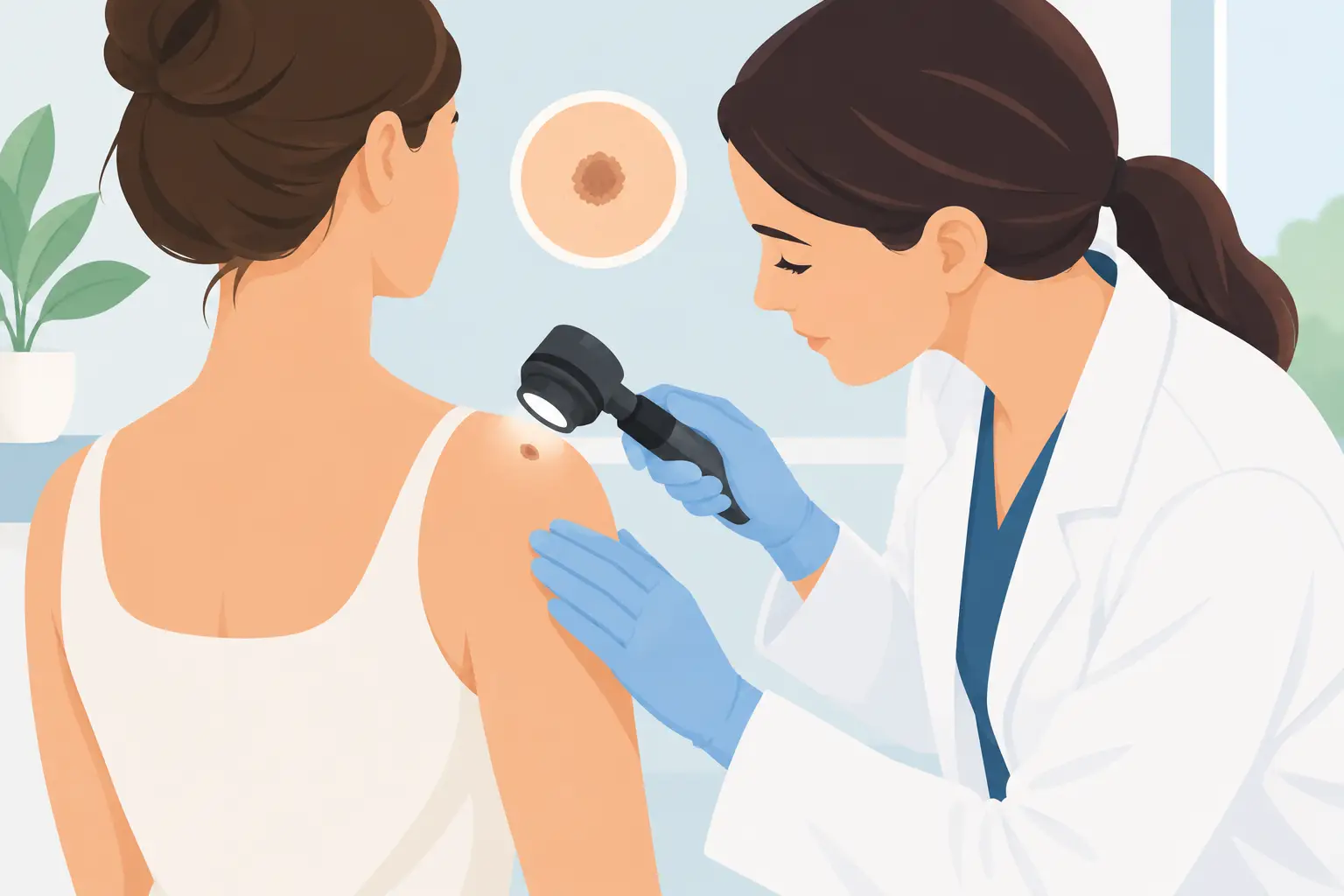
A professional assessment begins with questions about when you first noticed the mark and how it has changed. The clinician will examine the lesion and may inspect other areas of skin where appropriate. They may use a dermatoscope, a handheld device with magnification and specialised lighting that helps them see structures below the skin surface more clearly.
A dermatoscope supports clinical judgement, but it is not a diagnosis on its own. Depending on the findings, you may be reassured, advised to monitor the area, asked to return for review, or referred to a dermatologist or specialist service. If a lesion needs a definitive diagnosis, this is usually made by examining a small tissue sample under a microscope after removal or biopsy.
It is sensible to arrive prepared. Make a note of when you noticed the change, whether it has grown or bled, and whether you have symptoms such as itching or pain. Bring photographs if you have them, but do not worry if you do not. The examination remains useful without them.
Sun protection is part of prevention, not a substitute for checks
Protecting your skin reduces cumulative UV damage, but it does not remove the need to watch for change. Use broad-spectrum sunscreen with an SPF of at least 30 and good UVA protection when UV exposure is likely, applying it generously and reapplying according to the product instructions. Cover up with clothing, a wide-brimmed hat and sunglasses, and seek shade when the sun is strongest.
Sun protection is particularly relevant from March to October in the UK, though bright winter days and holidays abroad also warrant care. Avoid sunbeds altogether: they expose skin to intense UV radiation and increase the risk of skin cancer.
The aim is not to live anxiously around your skin. It is to make noticing it a normal part of looking after your health. A few unhurried minutes each month, followed by timely medical advice when something changes, can turn uncertainty into reassurance and ensure that concerns receive the attention they deserve.
Related articles

Private GP versus walk-in: Which Care Fits?
Private GP versus walk-in care: compare speed, continuity, costs and clinical scope, so you can choose the right support when you need it, close to home.

Best Options for Chipped Teeth Explained
Explore the best options for chipped teeth, from smoothing to bonding, veneers and crowns, with guidance on choosing treatment that best suits your smile.

How to Choose a Private GP With Confidence
Learn how to choose a private GP who offers timely appointments, continuity and clinical standards, so your care feels personal, trusted and convenient.


